"Without tradition, art is a flock of sheep without a shepherd.
Without innovation, it is a corpse."
Winston Churchill

G. K. Chesterton said, "Art is the signature of man." The cave walls of the world bear testimony to the enduring nature of that 'signature.' We don't know for certain why early man, or woman, painted on cave walls but we do know this- the earliest cave paintings demonstrate beautiful line, line that expresses confidence with economy. The cave paintings cry, "Paint what you mean and mean what you paint!"

Lascaux, France
The survival of ancient cave paintings is due to several factors. First, cave walls are protected from sunlight. Over time, sunlight fades pigment. Also, cave walls are protected from the elements; caves maintain consistent temperature and humidity levels. Finally, many of the caves are limestone, a material which has a special bonding relationship with pigment. One day, many years later, someone would use lime to make plaster as a wall covering. It was only a matter of time before someone painted on one of those walls.

Scrovegni Chapel
Giotto
Giotto di Bondone, student to Cimabue, has been called the 'Father of Western Painting.' His style blends tradition with innovation, capturing the essence of a story with new dimension. He also mastered the fresco process. Fresco is the Italian word for 'fresh.' The process involves painting on a lime plaster wall. When pigment is applied while the plaster is wet, or fresh, the process is called Buon Fresco; if applied after the plaster has dried it is called A Secco. The fresco panels by Giotto in the Scrovegni Chapel exhibit both Buon and A Secco techniques.


Expulsion From the Garden
Masaccio
Giotto's work influenced many artists, particularly a young painter from Tuscany. Born Tommaso di Ser Giovanni di Simone, he is generally known as Masaccio, which means 'messy.' According to Vasari, "He was absent-minded, whimsical, as one who, having fastened his whole mind and will upon the things of art, paid little attention to himself and still less to other people." Whereas Giotto captured dimension, Masaccio captured emotion. Masaccio also showed us he understood perspective. Masaccio's Holy Trinity is the first known example of linear perspective, a principle that fascinated an artist from Vinci named Leonardo.

The Holy Trinity
Masaccio
Leonardo da Vinci has been called homo universalis- a 'universal man.' A proficient painter, sculptor, engineer and musician (to name a few areas), Leonardo blended art and science.

Vitruvian Man
Leonardo
Leonardo apprenticed under Verrocchio, the Florentine Maestro. Innovation, not tradition, was the earmark of Leonardo's career, evidenced by drawings of numerous inventions and instruments of war. Sometimes his innovations with traditional media, like fresco, went awry.

The Last Supper
Leonardo
In 1495, Duke Ludovico Sforza commissioned Leonardo to paint a mural in the refectory at the monastery of Santa Maria delle Grazie. Three years later the Last Supper was finished.
Another artist influenced by Masaccio was Michelangelo Buonarroti, apprenticed at 13 to Ghirlandaio.

Creation of Man
Michelangelo
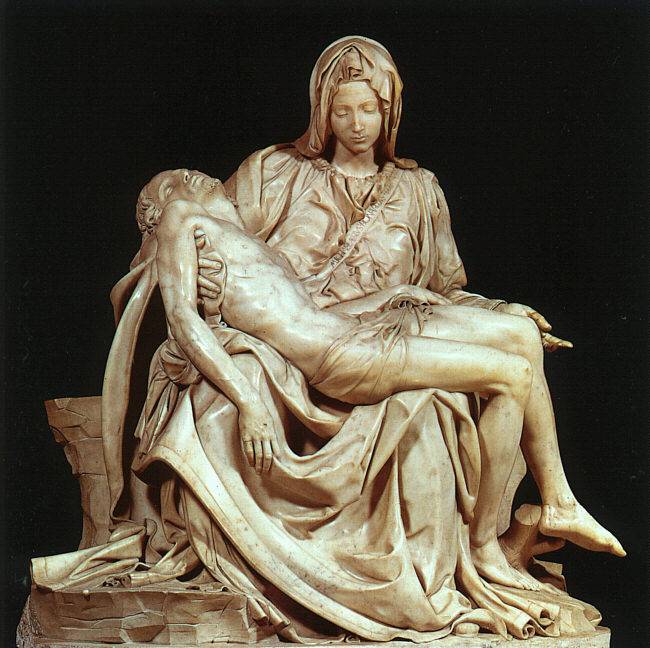
Though first trained as a painter, it was stone that caused Michelangelo's heart to sing.

Pieta
Michelangelo
Until the High Renaissance, artists did not tend to sign their work. Michelangelo signed the Pieta by carving 'Michelangelo Buonarotti made this' across Mary's sash. Michelangelo was also an architect. In 1546 he was appointed chief architect of St. Peter's Basilica in the Vatican. Michelangelo designed the cathedral's dome.

St. Peter's Basilica
Vatican
Our final artist is Raphael Santi, the first artist we have discussed this quarter whose father was also a painter. Giovanni Santi was court painter to the Duke of Urbino. In the Spring of 1483, Raphael was born. By age 11, both of Raphael's parents were dead.

The School of Athens
Raphael
In 1508 Pope Julius II commissioned Raphael to decorate the walls of the Stanza della Segnatura. Raphael frescoed The School of Athens, in which he portrayed Leonardo da Vinci as Plato, Michelangelo as Heraclitus and himself as Apelles, a renowned painter of ancient Greece. The School of Athens is a masterpiece of fresco art.
And so, we come full circle. From the dawn of time to the present, from caves to cathedrals, artists have painted on walls.