Showing posts with label Michelangelo. Show all posts

Saturday, March 10, 2012

Is it Finished?

"The greater danger for most of us lies not in setting our aim too high and falling short; but in setting our aim too low,
and achieving our mark."
Michelangelo Buonarroti
1475-1564

Definition source- Webster's Encyclopedic Unabridged Dictionary
of the English Language

     Recently, I received this email-
Mr. Carter,

I have enjoyed your art blog all year. Can you tell me how you determine the pieces to post? For example, do the students volunteer to have their art work posted or do you choose? Are the postings from specific classes?

These are good questions. Thank you for asking. Before answering, I feel that I should begin by answering 'Why an art blog?'  The answer is twofold:

1. To encourage students by showcasing their work online
2. To inform parents by providing 'week-at-a-glance' chapters

     That being said, how are the pieces selected? By asking the same question that I ask when grading student artwork,

"Is the assignment finished?" 

     The best work, regardless of the field or discipline, is work that is finished. Encouraging a teenager to finish something (whether it is a drawing assignment or eating their vegetables) is one of the greatest challenges a High School teacher faces. Everyday.

     Definitions are important. A wise teacher once told me, "You don't really know the meaning of a word until you can explain the word to someone else." Having taught art in seven schools, ranging from Kindergarten to University level, I use the following definition-

     finished- complete to the best of the student's technical and imaginative ability, after the student has considered the assignment, the materials and the suggestions offered by the teacher.

The Art Room
Can you find the three Megans?


     This week in Art History we discussed the period known as Modern Art, a time of re-defining the word finished. Type 1913 Armory Show into your search engine for an overview of this week's lecture. In the studio classes we continued paper casting from plaster molds and bookmaking.

     Here are a few recently finished pieces from Trinity students:

Alli's Hand
Cast Paper
Alli Meyer

Vase
Eric Smith

Plaster Molds

Etching
Paul Venturo

Etching
Megan Bennett


     The Art Room has a brand new cork board, roughly measuring 4' X 8', thanks to Mr. Emmett Higdon (Jack's Dad). Mr. Higdon delivered and mounted the board! Thank you, Mr. Higdon.

Sunday, October 23, 2011

From Caves to Cathedrals, A First Quarter Study Guide

"Without tradition, art is a flock of sheep without a shepherd.
Without innovation, it is a corpse."
Winston Churchill


G. K. Chesterton said, "Art is the signature of man." The cave walls of the world bear testimony to the enduring nature of that 'signature.' We don't know for certain why early man, or woman,  painted on cave walls but we do know this- the earliest cave paintings demonstrate beautiful line, line that expresses confidence with economy. The cave paintings cry, "Paint what you mean and mean what you paint!"

Lascaux, France

The survival of ancient cave paintings is due to several factors. First, cave walls are protected from sunlight. Over time, sunlight fades pigment. Also, cave walls are protected from the elements; caves maintain consistent temperature and humidity levels. Finally, many of the caves are limestone, a material which has a special bonding relationship with pigment. One day, many years later, someone would use lime to make plaster as a wall covering. It was only a matter of time before someone painted on one of those walls.

Scrovegni Chapel
Giotto

Giotto di Bondone, student to Cimabue, has been called the 'Father of Western Painting.' His style blends tradition with innovation, capturing the essence of a story with new dimension. He also mastered the fresco process. Fresco is the Italian word for 'fresh.' The process involves painting on a lime plaster wall. When pigment is applied while the plaster is wet, or fresh, the process is called Buon Fresco; if applied after the plaster has dried it is called A Secco. The fresco panels by Giotto in the Scrovegni Chapel exhibit both Buon and A Secco techniques.


Expulsion From the Garden
Masaccio

Giotto's work influenced many artists, particularly a young painter from Tuscany. Born Tommaso di Ser Giovanni di Simone, he is generally known as Masaccio, which means 'messy.' According to Vasari, "He was absent-minded, whimsical, as one who, having fastened his whole mind and will upon the things of art, paid little attention to himself and still less to other people." Whereas Giotto captured dimension, Masaccio captured emotion. Masaccio also showed us he understood perspective. Masaccio's Holy Trinity is the first known example of linear perspective, a principle that fascinated an artist from Vinci named Leonardo.

The Holy Trinity
Masaccio

Leonardo da Vinci has been called homo universalis- a 'universal man.' A proficient painter, sculptor, engineer and musician (to name a few areas), Leonardo blended art and science.

Vitruvian Man
Leonardo

Leonardo apprenticed under Verrocchio, the Florentine Maestro. Innovation, not tradition, was the earmark of Leonardo's career, evidenced by drawings of numerous inventions and instruments of war. Sometimes his innovations with traditional media, like fresco, went awry.

 The Last Supper
Leonardo

In 1495, Duke Ludovico Sforza commissioned Leonardo to paint a mural in the refectory at the monastery of Santa Maria delle Grazie. Three years later the Last Supper was finished. 

Another artist influenced by Masaccio was Michelangelo Buonarroti, apprenticed at 13 to Ghirlandaio. 

Creation of Man
Michelangelo

Though first trained as a painter, it was stone that caused Michelangelo's heart to sing.

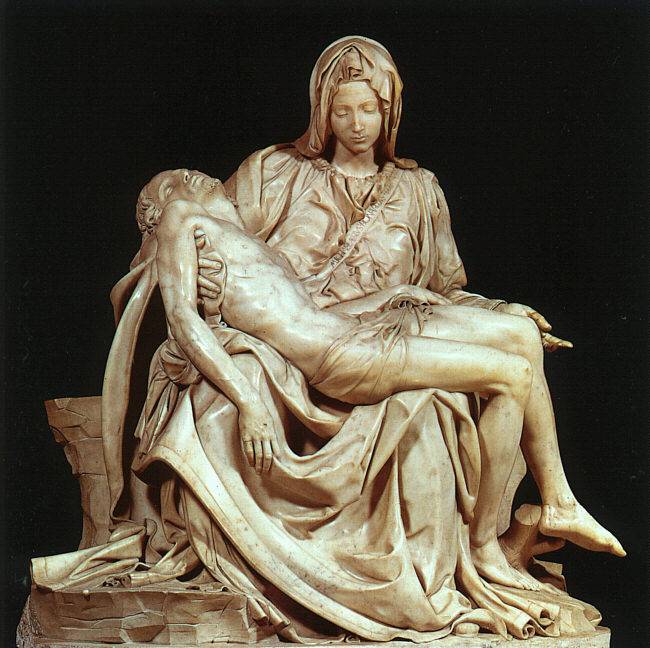
Pieta
Michelangelo

Until the High Renaissance, artists did not tend to sign their work. Michelangelo signed the Pieta by carving 'Michelangelo Buonarotti made this' across Mary's sash. Michelangelo was also an architect. In 1546 he was appointed chief architect of St. Peter's Basilica in the Vatican. Michelangelo designed the cathedral's dome.

 St. Peter's Basilica
Vatican

Our final artist is Raphael Santi, the first artist we have discussed this quarter whose father was also a painter. Giovanni Santi was court painter to the Duke of Urbino. In the Spring of 1483, Raphael was born. By age 11, both of Raphael's parents were dead.

The School of Athens
Raphael

In 1508 Pope Julius II commissioned Raphael to decorate the walls of the Stanza della Segnatura. Raphael frescoed The School of Athens, in which he portrayed Leonardo da Vinci as Plato, Michelangelo as Heraclitus and himself as Apelles, a renowned painter of ancient Greece. The School of Athens is a masterpiece of fresco art.

And so, we come full circle. From the dawn of time to the present, from caves to cathedrals, artists have painted on walls. 

Wednesday, May 25, 2011

One Last Lecture

"Every time someone tries to be like someone else they help form a category."
Samuel Carter

Humans like to categorize. Categories help us form paradigms, and they help us remember where to find things. Art is about categories. Media, theme, style, period...categoria ad nauseum. Aristotle lists ten categories in Organon, the first being substance or essence. Art is inherently prophetic- the maker imparts to the thing made substance. The viewer interprets. A conversation begins. Conversation abounds in the Art Room at Trinity (see below for examples).


Pieta
1498-99
Michelangelo

One last lecture.
This week, students viewed ten works of art that have survived humankind, in spite of physical abuse (intentional and unintentional). Here is the list:

Fountain
Marcel Duchamp
Night Watch
Rembrandt van Rijn
Danae
Rembrandt van Rijn
Rokeby Venus
Diego Velazquez
The Virgin and Child With St. Anne and St. John the Baptist
Leonardo da Vinci
Portland Vase
Maker Unknown
The Little Mermaid
Edvard Eriksen
Pieta
Michelangelo Buonarroti
The Actor
Pablo Picasso
Le Reve
Pablo Picasso 

To download the powerpoint, Ten Famous Works of Art (damaged and abused)click here.


New work from the students

Photo Serigraph
Madeline Keller

Serigraph
Mechal Harward

Serigraph
Tori Barbee


Watercolor
Samuel Carter


Serigraph
Alli Meyer


Acrylic on Canvas
CiCi Culp


Photo Serigraph on t-shirt from pinhole photo
Davis Martinec


Charcoal and Latex on paper
Michelle Berry


It's Not Lupus
Serigraph
Jack Traynor


Give Peace A Chance
Photo Serigraph
Izak Gainor


Photo of the Week


One Last Thing
A Short Film by Matt Deitch

Friday, October 22, 2010

From Giotto to Raphael

Maesta
Giotto di Bondone


THE OFFICIAL
TRINITYPREPART
STUDY GUIDE TO
ART HISTORY TEST #1


"Surely all art is the result of having been in danger,
of having gone through an experience all the way to the end,
to where no one can go any further."
Rainer Maria Rilke


The story of art
is the story of people. So, we begin our study of Western Art with Giotto.

Giotto
ca.1267-1337

Giotto, according to Vasari, was the student of Cimabue, Maestro of Florence. Cimabue followed the Byzantine tradition. Giotto did not.


The Madonna and Child is a theme that has been painted countless times. It is Giotto that breathed life into Mary and the Christ, creating a shift from stylized form to human form. It is Giotto that, for the first time, made us believe Mary is occupying space in the third dimension. 

Nativity
Scrovegni Chapel
1304-1306 

Using both Buon Fresco (wet) and Fresco Secco (dry), Giotto inspired generations of artists. In the Upper Church, Assisi, Giotto painted scenes from the life of St. Francis.

Sermon to the Birds
Upper Church, Assisi
1277-1279

People do not follow movements. People follow people. Giotto opened a door that Masaccio walked through.

Masaccio
1401-1428

Masaccio was not his 'real' name, it was a nickname (masaccio means 'messy' or 'slob'). The painter's given name was Tommaso di Ser Giovanni di Simone. Masaccio is easier to remember. When it came to the fresco, Masaccio was anything but messy. Masaccio gave paint the ability to express emotion.

The Expulsion From the Garden of Eden
1426-1427
Brancacci Chapel, Florence

Masaccio gave paint the ability to tell stories.

Tribute Money
1426-1427
Brancacci Chapel

Masaccio also showed the world, for the first known time in Western Art, linear perspective.

Trinity
1425-1428
Santa Maria Novella

Masaccio built on the foundation Giotto laid, ushering in the age known as
Renaissance.

There are three undisputed 'Grand Masters' of the Renaissance-
Leonardo, Michelangelo and Raphael.

Leonardo da Vinci
1452-1519

Homo Universalis, or in the Greek, Ï€Î¿Î»Ï…μαθής, refers to one who excels in many things- a universal man. Leonardo was such a man. Student of Verrocchio, Leonardo was a scientist, engineer, inventor, architect, musician, anatomist, poet, botanist, mathematician, and cartographer. Leonardo also painted.


La Gioconda
1503-1507


To list Leonardo's contributions to art (and the world) would exhaust any time or space this post can afford. Let us be content with two words-
chiaroscuro ('from light to dark') and sfumato ('to vanish' or 'to shade').


Chiaroscuro and Sfumato


Grand Master #2- Michelangelo Buonarroti, 1475-1564, was born in the Tuscany region of Italy and studied under the maestro Ghirlandaio. 


Pieta
1499


Though a Universal Man himself, Michelangelo was to stone what Leonardo was to science. Michelangelo was 24 years old when he carved The Pieta. It is the only piece he signed his name to.
He also painted.


Sistine Chapel
1508-1512


Grand Master #3- Raphael
1483-1520


Raphael studied under the Umbrian master Perugino. Raphael's life was brief, and yet, he imparted elegance to his figures.


The Alba Madonna
1511


Raphael also captured all three Grand Masters in one fresco.
The School of Athens
1509


From Giotto to Raphael, a period of 150 years, in a matter of moments.

Wednesday, October 13, 2010

The Mural and The Wall

Aden and Sam, painting The Mural

"There are no shortcuts to any place worth going."
Beverly Sills

This week students began work on The Mural- a visual timeline of art history (click here to read about it). A select group are allowed to participate, namely students who:
Display maturity
Complete assignments (on time)
Follow directions
Demonstrate technical ability


Recent Additions to The Wall
The Wall is reserved for exceptional work


Davis Martinec

Gaines Hargrove

Ian Edwards

Sam Carter

David Rogers


This week in Art History we look at the life of Michelangelo, who after five hundred years is still in the news (click here).


Here are a few students at work
Parker Ramsey,pulling a silk screen with a broken arm

John and Travis

Gracelet thread